The difference between round-headed and flat-headed Pogo pin
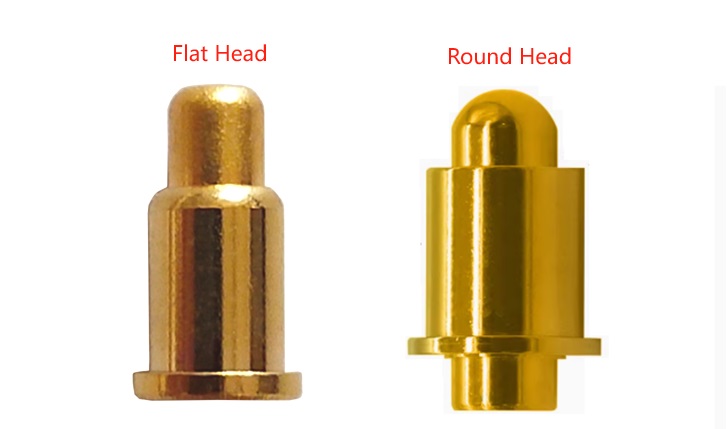
As a core component of precision connectors, the design of pogo pin heads directly affects connection stability, electrical performance, and service life. Round and flat heads, as the two most common needle tip forms, have significant differences in structural principles, application scenarios, and performance. The following details are elaborated from six dimensions:
-
Round head design: Adopts a spherical or arc-shaped contact structure, with a "point-surface" contact characteristic at the contact point. When the needle head contacts the contact surface, it forms an annular contact area centered on the circle center. The actual contact area increases non-linearly with pressure. For example, a round head needle with a diameter of 2mm has a contact area of approximately 0.3mm² under a pressure of 50 g (gram-force), and can reach 0.5mm² when the pressure increases to 100 g. This feature allows it to ensure effective contact even when the contact surface has slight unevenness or oxide layers.
-
Flat head design: Uses a planar contact structure, with a "surface-surface" fitting contact form. The contact area is directly determined by the diameter of the flat head of the needle. For example, a flat head needle with the same 2mm diameter has a stable contact area of about 3.14mm², and is not affected by pressure changes (within the elastic deformation range). This stability enables it to maintain more constant impedance characteristics during high-frequency signal transmission.
-
Contact resistance: Due to the dynamically adjustable contact area of the round head, the contact resistance is slightly higher under low pressure (about 50-100mΩ), but can drop to below 30mΩ as the pressure increases; the flat head, with a larger initial contact area, has more stable contact resistance (usually 20-50mΩ), making it more suitable for scenarios requiring low and stable impedance (such as power connections).
-
Signal integrity: In high-frequency scenarios, the stable contact area of the flat head can reduce impedance mutations. When transmitting signals above 10GHz, the insertion loss is 0.5-1dB lower than that of the round head. The round head, due to its concentrated contact points, performs better in low-frequency and high-current scenarios (such as battery connections) and can withstand instantaneous currents above 30A.
-
Corrosion resistance: The arc surface of the round head is not easy to accumulate water vapor and pollutants. In a humid environment (relative humidity above 90%), the contact resistance attenuation rate is 30% slower than that of the flat head; however, the planar structure of the flat head is more conducive to uniform coating coverage (such as gold plating thickness ≥0.5μm), resulting in better long-term oxidation resistance.
-
Plug-in life: The arc contact of the round head reduces the friction coefficient (about 0.15-0.2). With the same material (such as beryllium copper + gold plating), the plug-in life can reach more than 100,000 times; the flat head, with a higher planar friction coefficient (0.25-0.3), usually has a life of 50,000-80,000 times, but can be increased to 80,000-120,000 times by optimizing the coating hardness (such as nickel base thickness ≥3μm).
-
Vibration resistance: In the 10-2000Hz vibration test, the surface contact of the flat head can withstand a larger amplitude (1.5mm peak), and the connection interruption probability is 60% lower than that of the round head; the round head performs better in the impact test (1000G/0.5ms) because the arc structure can disperse the impact force.
-
Guiding fault tolerance: The arc shape of the round head has natural guiding properties, and can still automatically center when the matching deviation is ±0.2mm; the flat head requires higher installation accuracy (deviation ≤±0.1mm), but can make up for the lack of fault tolerance by adding a positioning pin structure.
-
Typical applications of round heads:
-
Consumer electronics: Smart watch charging contacts (frequent plugging and unplugging and possible stains on the contact surface)
-
Automotive electronics: Temporary detection interfaces for sensors (dynamic contact adjustment required in vibrating environments)
-
Medical equipment: Battery compartment connections for portable instruments (rapid connection required under low pressure)
-
Typical applications of flat heads:
-
Communication equipment: High-speed signal connectors for base station backplanes (stable impedance and vibration resistance required)
-
Industrial control: Fixed connections between PCB boards (low contact resistance drift required for long-term static placement)
-
Aerospace: Internal connections of precision instruments (requiring dimensional stability and low maintenance requirements)
-
Round head: The pressure at the contact point is concentrated (about 200-300MPa per unit area), which may leave tiny indentations on the surface of soft coatings (such as silver coatings). However, due to the diffusion of the contact area with pressure, it is not easy to cause coating peeling.
-
Flat head: The pressure distribution is uniform (about 50-150MPa per unit area), without local stress concentration. It is especially suitable for precision contact surfaces with thin gold plating (≤0.1μm), which can avoid contact failure caused by coating damage.
-
Processing difficulty: The round head requires precision grinding to ensure the spherical accuracy (tolerance ±0.01mm), and the processing cost is 15-20% higher than that of the flat head; the flat head can be formed by stamping or turning, which is suitable for mass production.
-
Assembly requirements: The round head has lower requirements on the flatness of the mating parts (≤0.1mm/m), while the flat head requires the flatness of the mating surface to be ≤0.05mm/m, otherwise local poor contact is likely to occur.
-
Compatibility design: The round head can be compatible with various contact surface forms such as convex surfaces and spherical surfaces, while the flat head is only suitable for flat or slightly concave contact surfaces, with lower design flexibility.
In summary, the choice between round and flat head designs needs to comprehensively consider contact stability, environmental adaptability, service life requirements, and cost factors. In practical applications, some high-end products will adopt a "round head + flat head" combination design (such as round heads for power pins and flat heads for signal pins) to achieve the optimal balance between performance and cost.

 WhatsApp:+8613652508770