Why does excessive current cause the Pogo pin to burn out?
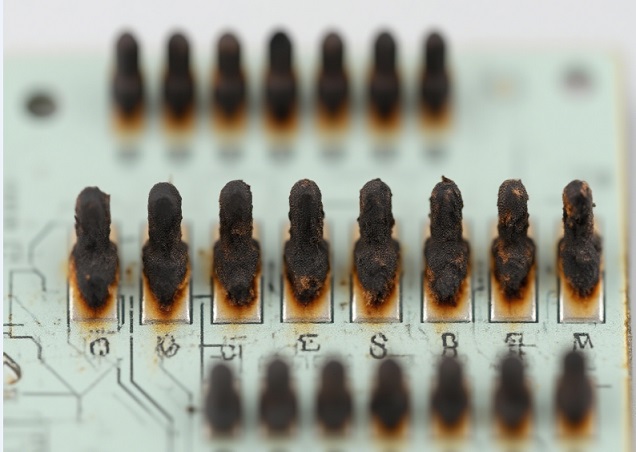
Pogo pins (spring-loaded pins) are precision electrical connectors widely used in consumer electronics, medical devices, industrial equipment, and other fields. Their core function is to achieve a stable electrical connection through the coordination of a pin, spring, and barrel. However, when the current flowing through a pogo pin exceeds its rated value, it is very prone to "burnout," manifesting as melting of the pin, deformation of the barrel, plating loss, or internal short circuits. This phenomenon arises from excessive current causing heat accumulation to exceed the tolerance limits of the pogo pin's material and structure. The specific mechanism can be analyzed from multiple perspectives, including the conductive path, heat generation, material properties, and structural failure.
1. Pogo Pin Conductive Path and Resistance Distribution
To understand the hazards of excessive current, it is first necessary to understand the pogo pin's conductive path. A typical
Pogo pin consists of three parts:
- Needle: Typically made of a copper alloy (such as beryllium copper), with a surface coating (such as gold or nickel) to reduce electrical resistance and enhance corrosion resistance. It directly contacts the mating component (such as a PCB pad or electrode);
- Tube: Typically made of brass or stainless steel, it serves as the primary channel for current conduction and provides support for the needle and spring;
- Spring: Typically made of stainless steel or music steel wire, its primary function is to provide spring force, ensuring tight contact between the needle and the mating component. In some designs, the spring also participates in electrical conduction.
After current flows from the mating component into the needle, it passes through the contact area between the needle and the tube, then through the tube itself, and ultimately out. (Whether the spring is conductive depends on the design; in some designs, the spring serves only a mechanical function and does not participate in electrical conduction.) In this path, the resistance of the contact area is much higher than the resistance of the metal itself. For example, the contact between the needle tip and the needle barrel is typically point or line contact, with a contact area of only 0.01-0.1 mm² (much smaller than the cross-sectional area of the needle barrel). Surface roughness, plating uniformity, and spring pressure fluctuations further increase contact resistance. Furthermore, if the plating (such as gold) has pinholes or wear, the exposed base metal (such as copper) will oxidize and form an oxide layer. The resistivity of the oxide layer is 10⁴-10⁵ times that of copper, significantly increasing the local resistance.
These high-resistance areas (especially the contact points and oxide layer) are the "weak links that first heat up when the current is too high" and are the primary sites of burnout.
2. Joule's Law: Excessive Current and Exponential Heat Growth
The heat generated when current passes through a conductor follows Joule's law: the heat is proportional to the square of the current.
For example, a Pogo pin rated at 1A has a total resistance (including contact resistance) of approximately 50mΩ (0.05Ω). When the current is at the rated value of 1A, the heat generated per second is relatively small. If the current increases to 5A (5 times the rated value), the heat generated per second is 25 times the rated value. At 10A, the heat generation soars significantly, reaching 500 times the rated value.
This exponential increase in heat can quickly disrupt the pogo pin's "heat generation-dissipation balance." Pogo pins are tiny (typically 5-20mm in length and 1-3mm in diameter), and heat dissipation relies primarily on heat conduction from the metal body (dissipating heat to the surrounding structure). With a heat dissipation area of only 0.1-1cm², the heat dissipation efficiency is extremely low. When the heat generation rate far exceeds the heat dissipation rate, heat rapidly accumulates within the pogo pin (especially in high-resistance areas), causing a sharp increase in temperature.
III. High-Temperature Material Damage: Melting, Oxidation, and Performance Degradation
The core materials (metal and plating) of a pogo pin are extremely temperature-sensitive. When temperatures exceed their tolerance limits, irreversible damage occurs:
1. Metal Melting and Structural Deformation
The needle and barrel are primarily made of a copper alloy (such as beryllium copper), which has a melting point of approximately 800-1000°C; the spring is typically made of stainless steel, which has a melting point of approximately 1400°C. When the local temperature rises to the melting point of the copper alloy due to excessive current flow, the contact area of the needle or barrel melts first, causing deformation and adhesion to the inner wall of the barrel. For example, if the contact point temperature reaches 1083°C (the melting point of pure copper), the tip of the needle melts into a liquid state, losing effective contact with the mating component. Furthermore, liquid metal may flow into the barrel and adhere to the spring, causing the pogo pin to become completely stuck.
2. Plating Failure and Increased Resistance
Plating (such as gold and nickel) is designed to reduce contact resistance and prevent oxidation. However, the thickness of the plating is typically only 0.1-5μm (gold is even thinner, approximately 0.1-1μm), and its heat resistance is limited. Gold has a melting point of 1064°C, but above 300°C it diffuses and reacts with the copper substrate, forming a brittle alloy (Au-Cu), which causes the plating to crack. Nickel has a melting point of 1455°C, but above 600°C it oxidizes to form NiO, which has a resistivity 10⁴ times that of nickel. When excessive current causes the temperature to exceed the plating's tolerance limit, the plating will peel, crack, or oxidize. The exposed copper substrate will rapidly oxidize, forming a high-resistance oxide layer, further exacerbating heat generation (creating a vicious cycle of "increased resistance → more heat → greater resistance").
3. Spring Force Loss
The spring force of a spring depends on the elastic deformation of the material, and the elasticity of stainless steel springs comes from the "cold work hardening" process (increasing strength through mechanical deformation). When temperatures exceed 200-300°C, stainless steel undergoes "annealing"—the internal grains rearrange, eliminating the cold work hardening effect and causing a decrease in elastic modulus. If the temperature exceeds 600°C, the spring loses its elasticity completely. Once the spring fails, the pin cannot maintain sufficient pressure to maintain firm contact with the mating component. Contact resistance increases from tens of milliohms to hundreds of milliohms or even several ohms, further increasing heat generation and ultimately leading to complete failure of the pogo pin
magnetic connector.
IV. Impact of Instantaneous High Current: Additional Damage from Surges and Arcing
In addition to sustained excessive current, instantaneous high currents (such as surges and short-circuit currents) can cause even more severe damage to pogo pins. For example, during a sudden short circuit, the current can surge to tens or even hundreds of amperes within milliseconds. Even with a very brief current-carrying period (e.g., 10ms), Joule's law can generate thousands of joules of heat, enough to instantly melt the pin.
Even more dangerously, this instantaneous high current can trigger arcing. When excessive current causes the contact point to heat up rapidly, the air breaks down, forming an arc (similar to lightning). The arc temperature can reach 3,000-10,000°C, far exceeding the melting point of any metal. This arc can directly burn the needle tip and mating component, forming pits or nodules, and damaging the smoothness of the contact surface. Furthermore, the high temperature generated by the arc accelerates oxidation and melting of the needle tube and spring, leading to instantaneous damage to the pogo pin.
5. The Significance of Designing the Rated Current: Balancing Heat Generation and Dissipation
The rated current of a pogo pin is not arbitrarily set; it is a safety threshold calculated by the manufacturer based on material properties, structural design, and heat dissipation requirements. For example, a pogo pin with a diameter of 2mm and a length of 10mm is typically rated at 1-3A. This value ensures that, when continuously energized, the heat generation and dissipation rates are balanced, with the maximum temperature not exceeding 120°C (well below the melting point of the material and the failure temperature of the coating).
When the actual current exceeds the rated value, this balance is disrupted, and the temperature continues to rise until the material fails. Therefore, the essence of "burnout due to excessive current" is that current exceeding the rated value disrupts the thermal balance of the pogo pin, triggering a chain reaction of material melting, oxidation, and structural deformation, ultimately leading to electrical connection failure.
The core mechanism of excessive current causing pogo pin burnout is excessive heat accumulation driven by Joule's law: the squared increase in current causes a surge in heat generation in high-resistance areas (such as contact points and oxide layers). The pogo pin's limited heat dissipation capacity is unable to dissipate this heat in a timely manner, causing a rapid temperature rise. When the temperature exceeds the material's tolerance limit, it can cause metal melting, plating failure, and spring annealing, ultimately compromising the pogo pin's electrical and mechanical properties. Therefore, strictly controlling the current within the rated value in the application is key to preventing pogo pin burnout.

 WhatsApp:+8613652508770