Why is the surface of Pogo pin easily scratched?
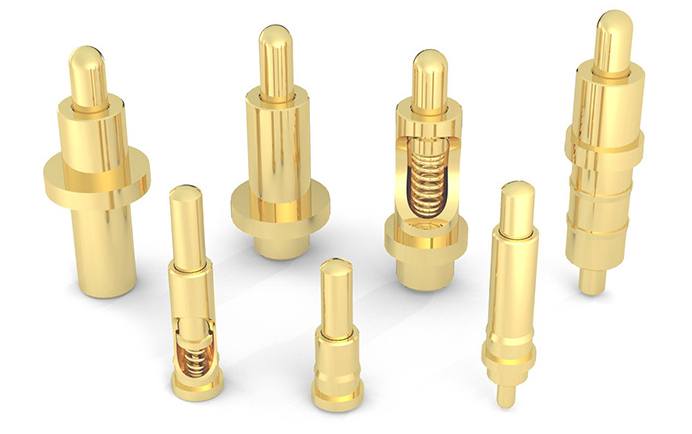
Pogo pins (spring-loaded pins), core components of precision connectors, are widely used in consumer electronics, medical devices, communications terminals, and other fields. Their surface quality directly impacts their conductivity, corrosion resistance, and service life. However, in practice, pogo pin surfaces are highly susceptible to scratching. This problem stems from a combination of factors, including material properties, processing techniques, and operating environment. This can be analyzed in depth from the following perspectives:
1. Intrinsic Limitations of Pogo pin Surface Plating
Pogo pins' electrical conductivity and corrosion resistance primarily rely on surface plating (such as gold, nickel, and palladium-nickel alloys). The physical properties of these platings make them prone to scratching.
In terms of material hardness, mainstream platings are generally lower than the impurities or substrates they may encounter in contact scenarios. For example, the Vickers hardness of commonly used pure gold plating is only 80-120 HV. Even harder hard gold plating (containing cobalt or nickel alloys) only increases to 200-300 HV. Palladium-nickel alloy plating has a hardness of approximately 300-400 HV. However, plastic debris, metal dust (such as stainless steel dust, which has a hardness of approximately 500-700 HV), and even quartz particles from fingers (which have a hardness of up to 1100 HV) that may come into contact with connectors during assembly are significantly harder than the plating. When these hard foreign objects rub against or impact the plating surface, the plating is easily scratched.
In terms of the plating structure, the plating of Pogo Pins is mostly formed through an electroplating process, resulting in a layered deposition structure. There is a threshold for bonding between the plating and the substrate (typically brass or phosphor bronze). The Vickers hardness of a brass substrate is approximately 100-150 HV, which is close to that of a pure gold coating. However, the two materials differ in their lattice structure and thermal expansion coefficient. Improper process control during electroplating (such as incomplete pre-treatment or uneven current density) can weaken the coating's adhesion and form microscopic "weak interfaces." When the surface is subjected to lateral shear forces, the coating is prone to peeling scratches along the weak interfaces, rather than simple surface wear.
Furthermore, the precise thickness of the coating also exacerbates the visibility of scratches. The functional coating thickness of a Pogo Pin is typically between 0.1-5μm, with the gold coating often only 0.1-1μm. Such a thin coating provides little "cushion margin." Even with slight friction, the coating wears through, exposing the underlying, different-colored substrate (such as a nickel base or brass base), resulting in visible scratches. The actual damage depth may be as little as 0.05μm, yet it can already affect appearance and performance.
2. Damage Risks During Precision Machining and Assembly
The production of Pogo Pins involves multiple processes, including stamping, turning, electroplating, spring assembly, and testing. Each step presents the potential for scratches. Due to its delicate structure (the pin shaft diameter is often less than 1mm), extremely high machining precision is required, and even minor errors can lead to surface damage.
During the machining phase, insufficient tool precision (e.g., edge wear and poor finish) during stamping and turning can leave marks on the pin shaft surface. These marks are microscopic scratches. While subsequent electroplating can cover them, they create an uneven surface with raised and recessed surfaces, reducing surface wear resistance. Furthermore, if cooling and lubrication are insufficient during machining, metal debris can adhere to the workpiece surface, causing secondary scratches as the tool moves.
Post-electroplating processing is even more prone to scratches. After electroplating, pogo pins undergo cleaning, drying, and sorting. If impurities (such as metal particles from previous processes) remain in the cleaning tank, or if the drying racks and sorting trays lack a polished surface (such as burrs or scratches), the workpieces can rub against these components during handling or vibration. Especially during batch processing, the collision and stacking of pogo pins can directly wear away the plating, resulting in dense, fine scratches.
Human error during assembly is also a significant contributing factor. If operators fail to wear anti-static gloves, the oil and sweat from their fingers can adhere to the pogo pin surface, affecting conductivity and attracting dust, increasing the likelihood of scratches from friction. Unpolished assembly tools (such as tweezers and clamps) can have sharp edges or rough surfaces that can directly scratch the pogo pin plating. Furthermore, excessive force or misalignment during assembly can cause hard friction between the pogo pin and the connector housing, resulting in noticeable, long scratches.
3.Continuous Erosion from the Operating Environment and Contact Conditions
During the service life of a Pogo Pin, the complexity of contact scenarios and the constant effects of environmental factors will continuously increase the risk of surface scratches, which are often followed by a chain reaction of performance degradation.
From a contact friction perspective, the core function of a Pogo Pin is to conduct electricity through the elastic contact between the pin shaft and the mating terminal, a process that inevitably involves reciprocating friction. During insertion and removal, or during vibration, the pin shaft surface and the mating component experience slight relative sliding. If the mating component has burrs, an oxide layer, or impurities (such as dust or solder slag) on the surface, this sliding friction will transform into an abrasive action, directly creating grooves in the Pogo Pin's plating. For example, if dust is present in the Pogo Pin of a mobile phone charging port, the repeated friction caused by the insertion and removal of dust will cause the plating to rub repeatedly during insertion and removal, resulting in noticeable scratches within a short period of time.
Environmental pollutants can further amplify the scratching effect. In industrial environments, contaminants such as dust, oil, and metal debris can adhere to the surface of pogo pins. Contact pressure can embed these contaminants into the plating, forming abrasive particles. Vibration and friction during use can cause these particles to continuously wear away the plating, acting like sandpaper. In humid or dusty outdoor environments, moisture combines with contaminants to form a paste-like mixture, which not only reduces lubricity but also exacerbates electrochemical corrosion, making the plating more susceptible to scratching and peeling due to the combined effects of corrosion and friction.
In addition, improper maintenance can exacerbate the scratching problem. During maintenance on some equipment, operators may use rough rags or brushes to clean pogo pins, directly causing surface scratches. If foreign matter inside the connector is not promptly removed, it can accumulate between the pogo pin
magnetic connector and the mating component, causing further damage with each contact. Scratched plating loses its integrity, leaving the exposed substrate susceptible to oxidation and rust. Rust then becomes a new abrasive, creating a vicious cycle of scratches, corrosion, and more severe scratches.
4. Common Industry Challenges and Technological Optimization Directions
Pogo pin surface scratches are essentially a contradiction between "precision plating" and "complex operating conditions." The core issue lies in the mismatch between plating hardness and adhesion, and contact friction requirements. The industry has mitigated this problem through technological upgrades, such as adopting harder composite plating (such as gold-nickel-phosphorus alloys, which can reach hardnesses exceeding 400 HV), optimizing electroplating processes to enhance plating adhesion, improving assembly tool materials (such as using polytetrafluoroethylene or ceramic fixtures), and adding dust and water-resistant designs for operating environments. However, due to the stringent requirements of Pogo pins for conductivity, elasticity, and miniaturization, plating thickness cannot be increased indefinitely. Furthermore, increasing hardness is limited by its conductivity (generally, higher hardness results in slightly lower conductivity). Therefore, surface scratches remain a common challenge that must be continuously addressed in the precision connector industry.
Pogo pin surface scratches are a result of multiple factors, including material properties, processing techniques, and operating environment. Even minor oversights in any step can lead to surface damage. Solving this problem requires full-chain control from coating material research and development, production process optimization, assembly specification formulation to use and maintenance management, so as to improve the surface scratch resistance while ensuring its precise functions.

 WhatsApp:+8613652508770